Szia!
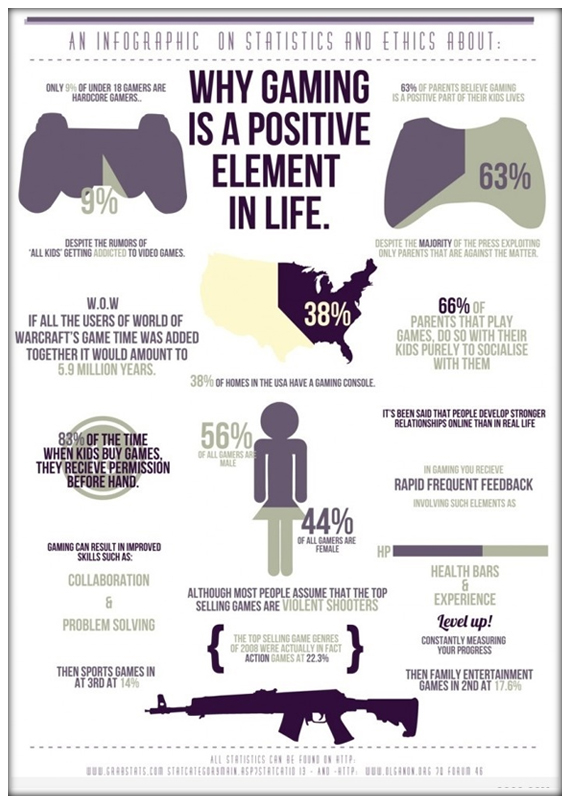
Good infographic
Monday, February 27, 2012
Posted by
Blog baruku
I like so much this infographic that shows the positive facts of gaming.
All information from http://www.grabstats.com/
Kinds of players
Tuesday, February 21, 2012
Posted by
Blog baruku
What kind of player are you? It's a complicated question and in fact there are a lot of kinds of players. Just to give an example we can talk about the proposed types of players in a Massive Multiplayer Online Game. Schreiber (2009) citing Bartle (1996) says that in this genre of game it's possible to identify four types of players:
•Achievers >> find it enjoyable to gain power, level up, and generally to “win” the game (to the extent that an ongoing, never-ending game can be “won”).
•Explorers >> want to explore the world, build mental maps of the different areas in their heads, and generally figure out what is in their surroundings.
•Socializers >> use the game as a social medium. They play for the interaction with other players. The gameplay systems are just a convenient excuse to get together and play with friends.
•Killers >> (today we call them “griefers”) derive their fun from ruining other people’s fun.
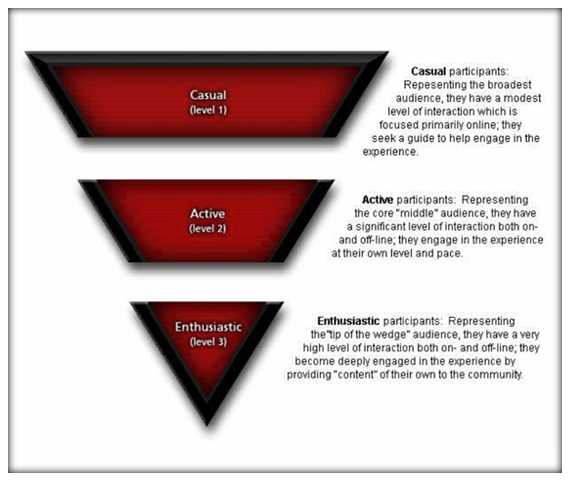
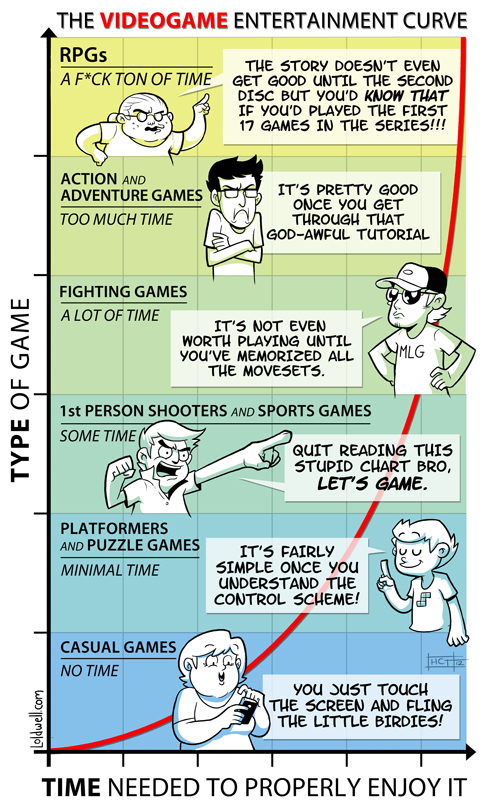
I think it's impossible to categorize all kinds of players of all gaming genres but I really like the synthetic idea of the graph below:
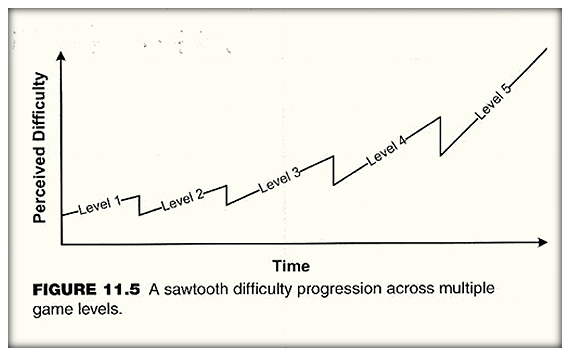
The most important point in the discussion about kinds of players is: know your audience to know how to create a consistent difficult progression and a good experience to the players. The next graph (from Fundamentals of Game Design, p.345) summarizes this thought:
I believe this is another fundamental concept to apply in game design.
What do you think about that?
References:
ADAMS, Ernest. Fundamentals of Game Design. New Riders: 2009
BARTLE, Richard. HEARTS, CLUBS, DIAMONDS, SPADES: PLAYERS WHO SUIT MUDS. Digital article (link here)
SCHREIBER, Ian. Kinds of Fun, Kinds of Players. Digital article (link here)
•Achievers >> find it enjoyable to gain power, level up, and generally to “win” the game (to the extent that an ongoing, never-ending game can be “won”).
•Explorers >> want to explore the world, build mental maps of the different areas in their heads, and generally figure out what is in their surroundings.
•Socializers >> use the game as a social medium. They play for the interaction with other players. The gameplay systems are just a convenient excuse to get together and play with friends.
•Killers >> (today we call them “griefers”) derive their fun from ruining other people’s fun.
I think it's impossible to categorize all kinds of players of all gaming genres but I really like the synthetic idea of the graph below:
What do you think about that?
References:
ADAMS, Ernest. Fundamentals of Game Design. New Riders: 2009
BARTLE, Richard. HEARTS, CLUBS, DIAMONDS, SPADES: PLAYERS WHO SUIT MUDS. Digital article (link here)
SCHREIBER, Ian. Kinds of Fun, Kinds of Players. Digital article (link here)
The concept of cybertext
Sunday, February 12, 2012
Posted by
Blog baruku
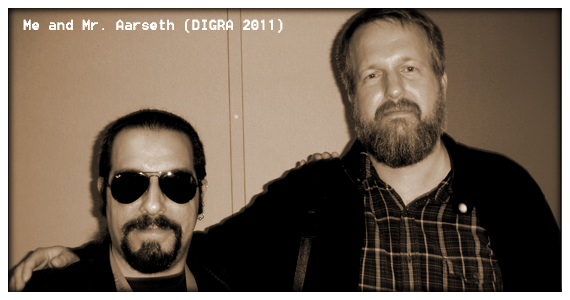
Last year (at DIGRA 2011/Netherlands) I had the honor to know personally one of my favorite authors: Espen Aarseth. Aarseth is a main figure in the fields of video game studies and electronic literature.
I really like some ideas from his book Cibertext and I want to share them in this post. I think that cybertext is an important concept inside the game design universe.
As Aarseth says:
The concept of cybertext focuses on the mechanical organization of the text, by positing the intricacies of the medium as an integral part of the literary exchange. However, it also centers attention on the consumer, or user, of the text, as a more integrated figure than even reader-response theorists would claim. The performance of their reader takes place all in his head, while the user of cybertext also performs in an extranoematic sense. During the cybertextual process, the user will have effectuated a semiotic sequence, and this selective movement is a work of physical construction that the various concepts of “reading” do not account for. This phenomenon I call ergodic, using a term appropriated from physics that derives from the Greek words ergon and hodos, meaning “work” and “path”. In ergodic literature, nontrivial effort is required to allow the reader to traverse the text. If ergodic literature is to make sense as a concept, there must also be nonergodic literature, where the effort to traverse the text is trivial, with no extranoematic responsibilities placed on the reader except (for example) eye movement and the periodic or arbitrary turning of pages. (page 1)
I believe this is a fundamental concept to apply in game writing.
I really like some ideas from his book Cibertext and I want to share them in this post. I think that cybertext is an important concept inside the game design universe.
The concept of cybertext focuses on the mechanical organization of the text, by positing the intricacies of the medium as an integral part of the literary exchange. However, it also centers attention on the consumer, or user, of the text, as a more integrated figure than even reader-response theorists would claim. The performance of their reader takes place all in his head, while the user of cybertext also performs in an extranoematic sense. During the cybertextual process, the user will have effectuated a semiotic sequence, and this selective movement is a work of physical construction that the various concepts of “reading” do not account for. This phenomenon I call ergodic, using a term appropriated from physics that derives from the Greek words ergon and hodos, meaning “work” and “path”. In ergodic literature, nontrivial effort is required to allow the reader to traverse the text. If ergodic literature is to make sense as a concept, there must also be nonergodic literature, where the effort to traverse the text is trivial, with no extranoematic responsibilities placed on the reader except (for example) eye movement and the periodic or arbitrary turning of pages. (page 1)
I believe this is a fundamental concept to apply in game writing.
What do you think about that?
Reference:
AARSETH, Espen. Cibertext: Perspectives on Ergodic Literature. The Johns Hopkins University Press: Maryland, 1997.
Reference:
AARSETH, Espen. Cibertext: Perspectives on Ergodic Literature. The Johns Hopkins University Press: Maryland, 1997.
Subscribe to:
Posts (Atom)
Labels
- .MOBI
- 2012
- 2013
- 2014
- 4 Minutes and 33 Seconds of Uniqueness
- aarseth
- abstract
- academic
- academic studies
- advergames
- advertising
- advertising effectiveness
- alan wake
- alea
- álmok
- analysis
- antwerp
- app store
- arcade
- arg
- Art
- art of failure
- article
- assassins creed
- atari
- batman
- batman: arkham origins
- bayer
- beer
- bejeweled
- belgium
- bernard suits
- beyond two souls
- Big Boss
- board game
- boardgame
- boardgames
- bogost
- book
- books
- borjomi
- Braid
- brain
- brand
- brazil
- brazil games show
- Brent Fox
- browser
- bruno faidutti
- business
- business model
- caillois
- campaign
- candy crush
- cannes
- cannes lions 2013
- card game
- casual
- casual game
- casual game design
- casual gamer
- casualgame
- ceilikan
- challenges
- chess
- Climate Game
- comics
- components
- concepts
- conference
- congress
- connection
- console
- Console/PC
- copenhagen
- core mechanics
- creative
- culture
- cyberculture
- danilo gentili
- data
- dd
- decision tree
- denmark
- Design
- device 6
- dice tower
- didget
- digital
- digital games
- DIGRA
- discussion
- dixit
- doctorate
- document
- documentary
- dominaedro
- domino
- doritos
- dots
- download
- Duet
- dungeon raid
- dungeons and dragons
- dynamics
- E3
- ecology
- education
- ellen page
- entertainment
- ergodic literature
- Eric Hautemont
- espen
- espen aarseth
- essay
- europe
- Exclusive
- exercises
- experience
- experiment
- F.R.O.G
- failure
- fair
- fan
- fandom
- fans
- fear
- fiction
- fighting
- flash
- frasca
- free
- freemium
- fun
- fun theory
- fundamentals of game design
- Future and Reality of Gaming
- game
- game design
- game designer
- game industry
- game mechanics
- game_design
- gamedesign
- gameplay
- gamers
- games
- games 4 business
- games for a better world
- gamification
- gaming
- gaming concepts
- gaming ecosystem
- gaming industry
- gaming market
- gaming studies
- gaming theory
- gaming_concepts
- gamingconcepts
- gauntlet
- GDC
- genre
- god of war
- gonzalo frasca
- Google maps
- graph
- graphics
- grasshopper
- haunted house
- health
- hints
- homo ludens
- horror
- huizinga
- ian bogost
- ICA 2013
- ICO
- ideas
- ideias
- iga
- image
- immersion
- in gamea dvertising
- Indie
- indie game
- industry
- infographic
- inspiration
- interactor
- interface
- interfaces
- interview
- ipad
- iphone
- iterative
- Jacques Ehrmann
- jane
- jane mcgonigal
- janet murray
- jenkins
- jesper juul
- jesse schell
- john cage
- Jonathan Blow
- journey
- keep it simple
- king.com
- knizia
- knowledge
- last of us
- learning curve
- lego
- Level Design
- life
- ludic
- ludic interface
- ludification
- ludofy
- ludology
- ludus
- magic circle
- magyar
- malaga
- market
- mass self-communication
- McGonigal
- meaning
- mechanics
- mediation
- memory game
- metagame
- metagaming
- microsoft
- mimicry
- minimal
- mobile
- mobile games
- modern games
- monster juice
- monument valley
- movie
- movies
- mulvihill
- mundial
- music
- narrative
- narratology
- new generation
- nintendo
- official millennials report
- old but gold
- old school
- online
- origins
- oxford
- paidia
- paper
- parsec
- pc
- persuasive games
- Philipp Stollenmayer
- play
- player
- player experiences
- players
- playstation 2
- playstation 3
- playstation 4
- playtest
- playtesting
- pong
- presentation
- procedural rhetoric
- process
- Production
- Programming
- project
- promotion
- prototype
- ps3
- publishers
- puzzle
- puzzles
- pyramyz
- quantic dream
- questions
- quotation
- quote
- quotes
- raph koster
- raptr
- re-mission
- reality
- research
- reward
- RPG
- rubik
- rules
- Rymdkapsel
- Sam Healey
- scott cohen
- serious games
- seriousgames
- shell
- sid meier
- Simogo
- simple
- simulation
- slender
- Smartphone/Tablet
- snack strong productions
- sneak beat bandit
- soccer
- social causes
- social media
- social network
- Social/Online
- society
- sometimes you die
- sony
- sound
- sound design
- space
- star wars
- strategy
- super hexagon
- t-shirt
- TED
- terror
- text
- texts
- the art of game design
- the new face of gamers
- theory
- tic-tac-toe
- Ticket to ride
- tips
- tíz
- Tom Vasel
- tower defense
- transmedia
- trends
- Twitch
- unfinished swan
- university
- uopia
- valve
- video
- video game
- video game cultures
- video games
- videogame fair
- videogames
- Vienna
- vincevader
- what is a game
- wii u
- Willem Dafoe
- Wright
- xbox 360
- xbox one
- xmas
- year walk
- yn
- zapp zerapp
- Zee Garcia
Popular Posts
-
I would like to write a special tribute to Dungeons & Dragons Role-Playing Game in my blog's 100th post. D&D was my first trul...
-
By Vince A long time ago, in the beggining of the 80's started a great video game revolution with the Atari system . A lot of titles fro...
-
"(...) a fictional genre that unites real life, treasure hunting, live-action, games and online communities. These games are an intens...
-
Sometimes I like to share some good quotes from great authors of ludology, narratology and gaming concepts areas. The quote below is from Pr...
-
Created by the developer Philipp Stollenmayer, SOMETIMES YOU DIE has become the surprise hit of 2014, despite (or perhaps because of) its u...
-
By Vince In this present post I want to discuss a wide notion of essential elements that we can find in any kind of game. Take a few seconds...
-
In this moment I'm writing a book named " LUDIFICATOR ". It's a quick reference guide for the newbie game designers. I hop...
-
By Gonzalo Frasca ( Thanks for share the text in my blog! ) ABSTRACT During the last few years, a debate took place within the game scholar...
-
Video games can evoke powerful emotions, and deeply affect the people who play them. Plenty of games have already proven that the medium is ...